

Switzerland 1896-1967
Architect, artist and designer
Swiss-born architect, artist and furniture designer Pierre Jeanneret (1896–1967) is renowned for his collaborative work with his cousin Charles-Edouard Jeanneret, better known as: Le Corbusier. Their partnership shaped modern architecture and design, blending innovation with functionality. Jeanneret’s individual contributions, particularly his technical vision and dedication, helped elevate their shared vision to modern architecture and design.
Pierre Jeanneret: Architect of Vision and Function
The Early Years and the Five Points Manifesto:
Jeanneret completed his architecture studies in Geneva before moving to Paris in 1920, where he worked at the Perret Frères architectural firm, which was known for its daring use of concrete and functionalist forms.
By late 1923, Jeanneret established an architectural office together with his cousin Le Corbusier at Rue d’Astorg 29, later renamed Atelier 35s, on September 1924. Together, they translated Le Corbusier’s groundbreaking ideas, which was aimed to the industrialization of life. Le Corbusier famously described the house as a “machine for living,” designed to minimize disruption to human freedom and the surrounding natural environment.
In 1926, Jeanneret and Le Corbusier published the groundbreaking manifesto, “Five Points Towards a New Architecture.” Which outlined principles that define their architectural aesthetic. Their ideas were materialized in the iconic Villa Savoye (1928–1931), a glass-encased, column-supported structure that appears to float above the ground. This building became a beacon of modernist design, embodying minimalism, light, and spatial fluidity.
Furniture Innovation and the Paris Salon d’Automne
Jeanneret’s creativity extended beyond buildings, into furniture design. In 1929, at the Paris Salon d’Automne, he collaborated with Le Corbusier and Charlotte Perriand to unveil a series of modern furniture pieces. Featuring tubular steel chairs, stools, and modular steel storage units, these designs embraced industrial materials and innovative construction. They exemplified the intersection of art and functionality, making high design accessible for contemporary living. These designs have become icons in the design history, which are still popular today.


Behind the Scenes: Jeanneret’s Role in the Partnership
While Le Corbusier often claimed the spotlight, Jeanneret played an indispensable role in their collaboration. Known for his pragmatism, he brought professionalism and order to their projects and also followed through on site. Jeanneret frequently drew the first sketches for plans that he then gradually reworked and refined with Le Corbusier, playing an important part in ensuring the continuity, coordinating work and maintaining tight control over all technical aspects.
The Chandigarh Project
In the 1950s, Jeanneret embarked on one of the most significant projects of his career: the design and planning of Chandigarh, India. Alongside Le Corbusier, they envisioned an urban landscape that combined efficiency with aesthetics. When Le Corbusier left midway through the project, Jeanneret assumed the role of Chief Architect and Urban Planning Designer. Over the next 15 years, he developed affordable housing and public buildings that reflected the needs of the local community while maintaining modernist principles. Chandigarh stands today as a testament to his dedication, a UNESCO World Heritage Site recognized for its pioneering architecture and urban planning.
 Pierre Jeanneret with his Indian colleagues.
 Pierre Jeanneret, sitting on his self-made chair.
 Pierre Jeanneret cycling his way to inspect the construction of the Secretariat building.
 Pierre Jeanneret and Le Corbusier, Chandigarh, between 1951 and 1965. Image courtesy: Pierre Jeanneret Fonds, Canadian Centre for Architecture, Gift of Jacqueline Jeanneret.
 Pierre Jeanneret, view of the Gandhi Bhawan at Punjab University, Chandigarh, India, circa 1963. Gelatin silver print, 9 x 14 cm. ARCH264912, Pierre Jeanneret fonds, CCA Collection. Gift of Jacqueline Jeanneret © CCA
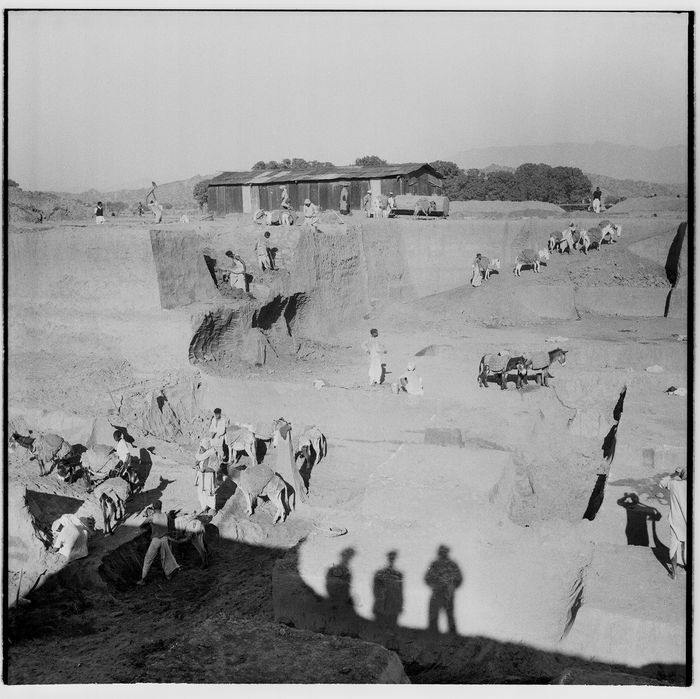 Pierre Jeanneret, excavation of the foundations for the High Court Building, Sector 1, Chandigarh, India, 1952. Negative, 6.3 × 6.2 cm. ARCH264696, Pierre Jeanneret fonds, CCA Collection. Gift of Jacqueline Jeanneret © CCA
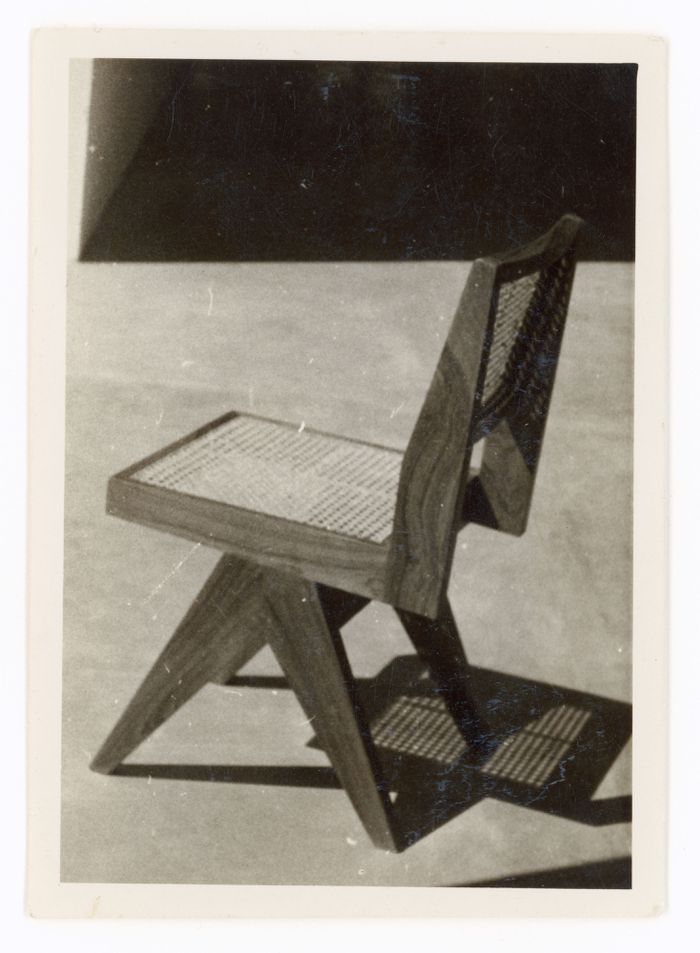 Unknown photographer, view of a chair designed by Pierre Jeanneret, Chandigarh, India, 1958-1979. Gelatin silver print, 8.5 × 5.7 cm. ARCH402419, Pierre Jeanneret fonds, CCA Collection. Gift of Jacqueline Jeanneret.
 Unknown photographer, the Assembly under construction in Chandigarh, India, 1950-1965. ARCH268830, Pierre Jeanneret fonds, CCA Collection. Gift of Jacqueline Jeanneret.
 Unknown photographer, view of an armchair designed by Pierre Jeanneret, Chandigarh, India, 1960-1979. Gelatin silver print, 8.3 × 5.8 cm. ARCH402421, Pierre Jeanneret fonds, CCA Collection. Gift of Jacqueline Jeanneret.
 Pierre Jeanneret, view of Gandhi Bhawan, Punjab University, Chandigarh, India, circa 1963. Gelatin silver print on paper, 8.1 × 12 cm. ARCH268826, Pierre Jeanneret fonds, CCA Collection. Gift of Jacqueline Jeanneret © CCA
 Pierre Jeanneret, elevations for the Gandhi Bhawan, Punjab University, Chandigarh, India, circa 1962. Diazotype on paper, 47.2 x 102.1 cm. ARCH268865, Pierre Jeanneret fonds, CCA Collection. Gift of Jacqueline Jeanneret © CCA
Where most of the Chandigarh project is credited to Le Corbusier, it is safe to say the Chandigarh we know of today would not exist without Pierre Jeanneret. Jeanneret lived in India from 1951 to 1965, and embraced the culture, people and honesty. He became familiar with the local context, climate, materials and designed buildings accordingly, and executed Le Corbusiers designs there. When reading about the history and creation of Chandigarh, there often comes to light that Pierre Jeanneret had a special character. He is often portrayed to have been a humble, straightforward, polite, down-to-earth, amicable and caring person, who was above all a creative spirit who had great adaptability to new environments. In his spare time from the work, Jeanneret began making paddle boats to explore the Sukhna lake, and designing furniture, of local spare materials. This furniture is know highly sought after and have become collectors items.
Pierre Jeanneret Furniture
The original intensions of Pierre Jeanneret when designing his furniture were to design honest furniture for the Chandigarh project and people, which could be hand made by the local community. Jeanneret himself had a clear vision about the attribution, he thought it belonged to India, as it was the Indian people who hand made each piece.
The quality, usage of materials and design were very important, and this can still be seen, as more than 70 years later and even after being disregarded from the buildings in this time frame, they can still used well with mostly only a minor restoration such as cane replacement or reupholstery. Another interesting and nowadays relevant fact about these and other Chandigarh chairs is that all pieces were made from the trees which were logged because the city was built, so an early adaptation of ecological thinking.
Below a few examples of the furniture Pierre Jeanneret designed and made for the Chandigarh project. These were placed in different buildings and can be recognized on the markings and provenance where they have been used for, for example in the Punjab University and administrative buildings. When looking at the authenticity these markers should be looked at very closely to ensure you have got an original: provenance, patina, materials and signature. We always keep close attention to the details before acquiring these pieces.


Pierre Jeanneret’s Legacy
Pierre Jeanneret’s work resonates as a blend of artistry, technical expertise, and social consciousness. From his early days in Paris, shaping purist and functionalist ideologies, to his iconic contributions in Chandigarh, his legacy endures. Whether through sleek tubular steel furniture or monumental urban landscapes, Jeanneret’s vision remains a cornerstone of 20th-century design.
Appears in the literature: “Le Corbusier, Pierre Jeanneret: Chandigarh, India,” Galerie Patrick Seguin, pp. 248 – 249, 288 and “Le Corbusier, Pierre Jeanneret: The Indian Adventure,” Touchaleaume and Moreau, p. 572.